
What Reid Hoffman Taught Cherno About Success and Leading Through Disruption.
A Conversation About Digital Disruption, Intelligent Risk, and the Art of Reinventing Yourself Again and Again
When Cherno meets LinkedIn co-founder and Silicon Valley visionary Reid Hoffman, he expects a conversation about start-ups, digital disruption, and the future of business. He gets far more!
It becomes a personal masterclass in leadership, artificial intelligence, transformation, and what it takes for people and companies to remain successful in revolutionary times. Sometimes, one sentence is enough to shake up everything you thought you knew about success.
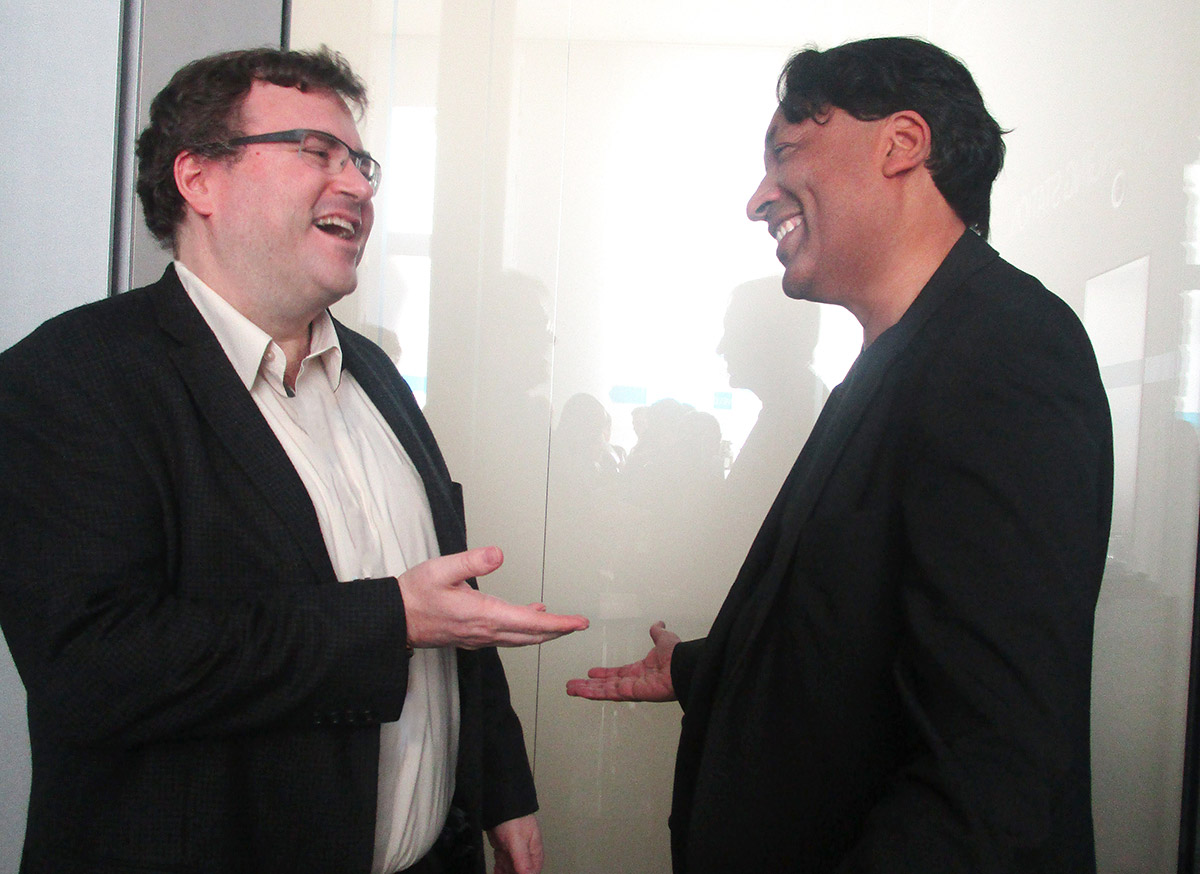
Hoffman speaks quickly and clearly, with the kind of playful confidence that suddenly makes complex ideas seem simple. And every time Cherno marvels at one of his radical metaphors, Hoffman seems quietly amused by his reaction.
To Reid Hoffman, these ideas are not spectacular Silicon Valley theories. They are simply reality.
The Future Doesn’t Wait for Permission
Cherno wants to know where people find the courage to start a company when they cannot possibly know whether their idea will work. Hoffman does not have to think for long: “One of the metaphors I use for start-ups is that you throw yourself off a cliff and assemble your airplane on the way down.”
Cherno looks at him in disbelief. Hoffman smiles. So this is his idea of entrepreneurship? Jump before the plane is finished? But Reid Hoffman is not advocating a blind leap. He is talking about the ability to learn under extreme pressure. About priorities. About making decisions before all the information is available.
Then he becomes serious: “If you don’t solve the right problem at the right time, that’s the end. Mortality puts priorities into sharp focus.”
The sentence amazes Cherno. Because it no longer applies only to the digital world of start-ups. It describes the situation facing many CEOs and executive boards.
Artificial intelligence is transforming business models before companies have finished evaluating their pilot projects. Competitors are emerging from beyond traditional industry boundaries. And while leadership teams are still working on the perfect strategy, others are already building the future.
If You’re Waiting for Certainty, You’re Already Late
Isn’t that dangerous? Isn’t it the responsibility of good leadership to avoid risk whenever possible? Again, that friendly smile.
To Reid Hoffman, the question itself seems to be based on a misconception. “People who take risks intelligently can usually make a lot more progress than people who don’t.”
Not every risk is smart. But taking no risk at all is often the most dangerous decision. “Everything in life has some risk, and what you have to learn is how to navigate it.”
Then Hoffman adds a sentence that sounds like a warning to every boardroom: “Remember: If you don’t find risk, risk will find you.”
Cherno marvels again. Hoffman is amused again.
But beneath his lightness is a precise leadership lesson: In revolutionary times, there is no risk-free path. Leadership is not about eliminating uncertainty. Leadership is about learning how to move through it.
The Greatest Risk Is Often the Attempt to Avoid Risk Altogether
Many companies treat change like a problem that must be controlled. But markets do not wait for approval. Technology does not follow organizational charts. And disruption does not ask whether a company is ready.
The real risk, therefore, is often not the courageous step forward. It is holding on. To a strategy that worked yesterday. To processes that create the illusion of security. To business models that are still profitable but already losing relevance.
This is precisely what impresses Cherno about Reid Hoffman: He does not talk about courage as an inspirational slogan. He treats courage as a strategic management capability.
Perfection Feels Safe! Until Speed Wins
The conversation turns to innovation. Cherno talks about the German ambition to do things thoroughly, deliver exceptional quality, and make everything as perfect as possible.
Reid Hoffman counters with one of his most famous statements: “If you aren’t embarrassed by the first version of your product, you shipped too late.”
Cherno has to laugh. An embarrassing first version as a principle of success?
To Hoffman, there is no contradiction. He is not advocating bringing bad products to market. He is talking about the speed of learning.
If you spend too long perfecting, you learn too late.
If you test too late, you hear from your customers too late.
If you wait until every doubt has been eliminated, you may enter a market that others have already shaped.
Hoffman’s message: Start earlier. Listen faster. Learn consistently. Improve relentlessly. Quality remains essential.
But in revolutionary times, standing still is not neutral. Standing still is a decision in favor of the past. Speed itself becomes part of quality.
20 Years of Experience Can Be One Year Repeated 20 Times
Okay, Cherno continues, but what about experience? After all, many companies consider it one of the most important qualifications for leadership responsibility. Surely, someone who has been around long enough must know how things work.
Hoffman clearly sees it differently: “For many people, twenty years of experience is really one year of experience repeated twenty times.”
Another one of those sentences. Short. Provocative. Uncomfortably true.
Cherno pauses for a moment. Hoffman seems to enjoy his amazement.
Because real experience does not come from time alone. It comes from reflection. From new challenges. From a willingness to question old beliefs.
A CEO may have decades of experience and still use yesterday’s mental models to address tomorrow’s challenges.
The decisive question is therefore not: How long have we been doing this? It is: What have we learned since then?
Stop Managing the Present. Start Building the Future.
But how do you avoid becoming trapped in the demands of daily business? Reid Hoffman’s answer sounds almost too simple at first: “I usually allocate time each week to work on topics outside of the normal workflow.”
Hoffman explains that these topics might involve multi-year strategies, theories about how the world is changing, or simply something new that opens up a different perspective.
“These topics can be multi-year strategies for work, theories of how the world is changing, or just something refreshingly different or new.”
For Cherno, this is one of the most important moments in the conversation. After all, the calendars of business leaders are usually filled with the present and the past: explaining numbers, solving problems, reviewing decisions, and managing expectations.
But who is thinking about what does not seem urgent today, yet could become existential tomorrow?
CEOs Don’t Need More Meetings. They Need More Future Time.
Strategic leadership requires time for the future. Time for questions such as:
- Which development are we currently underestimating?
- Which new competitor does not fit our traditional frame of reference?
- Which business model could disrupt our industry from the outside?
- Which capabilities will become more valuable because of artificial intelligence?
- Which uncomfortable truth remains unspoken in our meetings?
- What must we begin today if we still want to be relevant three years from now?
“Silicon Valley Is a Mindset, Not a Location”
When you meet a Silicon Valley legend, you naturally have to ask how he explains the extraordinary success of that place.
Is it the capital? The universities? The technology companies? The concentration of exceptional talent?
Reid Hoffman answers: “Silicon Valley is a mindset, not a location.”
Cherno marvels. Hoffman smiles.
Innovation is not tied to a ZIP code. It begins with an attitude. With curiosity. With speed. With the willingness to question your own formula for success.
Many business leaders travel to Silicon Valley, visit technology companies, and admire their culture of innovation. But the real transfer does not happen during a company tour.
It happens in your own mind. Am I willing to question my strongest convictions? Are people in my organization allowed to disagree? Can we learn from mistakes without immediately looking for someone to blame? Do we reward curiosity? Or only conformity? Innovation begins where status does not automatically defeat the better idea.
Your Career Is a Start-up. Are You Still Investing in Its Future?
The conversation becomes more personal. What can someone learn from Reid Hoffman’s way of thinking if they do not want to found a company but do want to shape their own career?
His answer: “You need to think and act like you’re running a start-up: your career.”
Your own life as a start-up? Once again, Hoffman can see Cherno’s amazement.
But the idea could hardly be more relevant. Titles do not protect you from disruption. Professional experience does not guarantee relevance. And even a powerful position can quickly lose its value if it is tied exclusively to one company, one industry, or one former formula for success.
That is why Reid Hoffman advises: “Establish an identity independent of your employer, city, and industry.”
What remains when the business card disappears? Which capabilities make you valuable beyond your current position? What perspective do you represent that makes people want to listen specifically to you? What impact do you have when hierarchy alone is no longer enough?
Executive presence does not come from voice, body language, or appearance alone. It begins with clarity about your identity, your value, and the direction you stand for.
Success Is Not an End Point. It Is a New Responsibility.
Reid Hoffman tells Cherno about a question he regularly asks himself: “Each year, I ask: Now that I have this knowledge and these resources, what can I do?” Not: What have I achieved? Not: What am I entitled to because of my success? But: What can I accomplish with it now?
This question changes the perspective of the conversation.
For Hoffman, success is not an end point. It is a new starting point. More knowledge, influence, and resources do not merely increase your opportunities. They also increase your responsibility.
For CEOs, executive boards, and decision-makers, this is a powerful challenge: What can you accomplish today that you could not have accomplished five years ago? Which decision has now become possible? Which change can you initiate now? Which responsibility can you no longer delegate?
What Got You Here Could Become What Holds You Back
Reid Hoffman has been at the forefront of technological change since his PayPal days. So how do you remain successful over the long term when technology, markets, and expectations are changing faster and faster?
Hoffman’s answer is unequivocal: “You have to be constantly reinventing yourself and investing in the future.”
For many successful people, that is precisely what makes reinvention so difficult. Success rewards repetition. When a certain behavior, product, or business model produces a victory, the instinctive response is to protect and repeat that formula. But what drove yesterday’s rise can become tomorrow’s obstacle.
“Finished” Should Be a Four-Letter Word for All of Us
Reid Hoffman explains: “For life in permanent beta, the trick is to never stop starting.” Permanent beta. Never entirely finished. Always learning. Always ready for the next version.
Hoffman continues: “Finished ought to be an F-word for all of us. We are all works in progress. Each day presents an opportunity to learn more, do more, be more, and grow more in our lives and careers.”
This may be the sentence that touches Cherno most deeply. Because it is more than advice for entrepreneurs. It is an attitude toward life.
The Moment You Think You’re Finished, You’re Already Falling Behind
Hoffman puts it with almost brutal clarity: “Get busy livin’, or get busy dyin’. If you’re not growing, you’re contracting. If you’re not moving forward, you’re moving backward.”
In a world of exponential change, standing still exists only as an illusion. A company can be profitable today and still be losing its future viability. A leader can be successful today while relying on capabilities that will no longer be sufficient tomorrow. A brand can be well known today while slowly becoming irrelevant. Transformation is therefore not a project with a beginning and an end. It is a permanent leadership responsibility.
Great Leaders Reinvent Before the Market Forces Them To
The difference between reacting and leading is timing. If you only change when revenue collapses, customers leave, or new competitors begin to dominate, you are no longer leading. You are reacting.
Strategic leadership begins earlier. It recognizes weak signals, asks uncomfortable questions, and invests in the company’s next version while the current one is still successful.
“When the Naysayers Get Loud, Turn Up the Music”
New ideas rarely produce immediate approval. They generate questions. Resistance. Sometimes ridicule. Cherno knows this from his own life: Anyone who breaks through boundaries, chooses a new path, or visibly challenges established expectations will almost inevitably encounter naysayers.
Hoffman expresses his response in true rock ’n’ roll fashion: “When the naysayers are loud, turn up the music.”
Cherno laughs. That is a line made for him.
As an emcee, speaker, executive coach, and musician, he knows that leadership is not about silencing every background noise. Leadership is about refusing to lose your own rhythm.
Criticism must be taken seriously. But not every doubt is wisdom. Not every tradition is experience. And not every consensus proves that a decision is right.
Sometimes agreement merely means that no one was willing to bring a truly new idea into the room.
Disruption Doesn’t Destroy Companies. Complacency Does.
Naturally, the conversation also turns to companies that confuse their strength with invulnerability. For Reid Hoffman, the American automotive industry is a cautionary example.
Customers demand smaller, more fuel-efficient vehicles. Many automakers continue building increasingly larger models. New competitors from Japan are underestimated. “Made in the USA” is still assumed to mean “best in the world.” Japanese manufacturers develop new lean production methods. Established corporations cling to their familiar processes. Performance is not always rewarded consistently. Seniority and internal relationships often carry more weight. Decisions slow down in an endless procession of committees. Careful coordination becomes “death by committee.”
The decline does not happen overnight. It develops through many small decisions that appear reasonable individually but collectively lead in the wrong direction.
The Most Dangerous Phase Begins After Success
That is precisely the warning for today’s CEOs and executive boards. Disruption rarely announces itself with a dramatic explosion. It begins with signals that can easily be ignored. With customer demands that do not fit the existing business model. With new competitors that initially appear insignificant. With technologies that still seem unfinished. Until the unfinished becomes better than the established.
Success Is More Fragile Than It Looks
Hoffman then quotes Intel co-founder Andy Grove and his famous motto: “Only the paranoid survive.” This does not mean fear-driven leadership. It means strategic vigilance. Success is fragile. Competitive advantages are temporary. Perfection never lasts.
The most dangerous moment often begins when leaders start taking their success for granted. When they believe the market owes them the same position tomorrow that they earned yesterday.
Reid Hoffman embodies the opposite during the conversation. Despite all his success, he does not speak like someone who has arrived. He speaks like someone who is already thinking about the next beginning.
The Most Uncomfortable Truth in the Room Could Be Your Greatest Opportunity
Reid Hoffman then turns to a standard question from the circle of PayPal founders: “What important truth do very few people agree with you on?”
The question sounds simple. But it is intellectually and psychologically demanding. Intellectually, because the knowledge everyone learns is, by definition, widely accepted. Psychologically, an honest answer is almost inevitably unpopular. Anyone who voices an uncomfortable truth risks disagreement—and sometimes status, approval, or career opportunities.
Brilliant thinking is rare. The courage to stand behind it is often rarer still.
For CEOs and executive boards, this question goes directly to the heart of strategic leadership: Which truth about your business model do you already know but still refuse to say out loud? Which truth about your corporate culture? About artificial intelligence? About the speed of your transformation? About your own leadership?
Strategic clarity often begins with the sentence no one in the room initially wants to hear.
“What Comes Easily to You May Be Your Most Valuable Asset”
Toward the end, the conversation becomes personal once again. How do people recognize where their unique value lies? Reid Hoffman answers: “Often it’s when you come in contact with challenges other people find hard, but you find easy that you know you’re in possession of a valuable soft asset.”
Many people underestimate the very ability that makes them distinctive.
What comes easily to them feels ordinary. Making complexity understandable. Bringing people together in difficult situations. Reading a room. Remaining calm under pressure. Holding conflicting ideas at the same time. Building trust. Telling a clear story when everyone else sees only numbers.
These abilities are often described as “soft skills.” But in an economy shaped by AI, digital transformation, and uncertainty, they are hard strategic capital.
Technology can scale knowledge. But trust, judgment, and human impact determine whether people will follow a new direction.
Why This Conversation Impresses Cherno So Deeply
It is not only what Reid Hoffman says. It is the ease with which he says it. Cherno marvels at the radical nature of his images. Hoffman reacts with friendly, almost mischievous amusement, as if to ask: Why does that surprise you?
To Hoffman, disruption is not an abstract management term.
It is a principle for life. Jump, even though the plane is not finished. Find the risk before the risk finds you. Start earlier. Learn faster. Do not confuse experience with repetition. Reserve time for the future. Run your career like a start-up. And never believe that you are finished.
Cherno does not leave the conversation with a ready-made formula for success. He takes away something more valuable: a new way of looking at success.
The Future Belongs to Learners, Not the Complacent
Success in revolutionary times does not mean having everything under control. It means remaining capable of action even when not everything can be controlled. Transformation rarely fails because of a shortage of PowerPoint. It fails when leaders act too late.
When they focus only on avoiding risks instead of learning to navigate them intelligently.
When they cling to yesterday’s formulas for success.
Or when their communication lacks the clarity, credibility, and energy that real change requires.
Reid Hoffman’s most important message is therefore not technological.
It is profoundly human: Do not wait for the future to become safe. Learn to act courageously within it.