
What Muhammad Yunus Taught Cherno About Leadership and Succeeding in Revolutionary Times
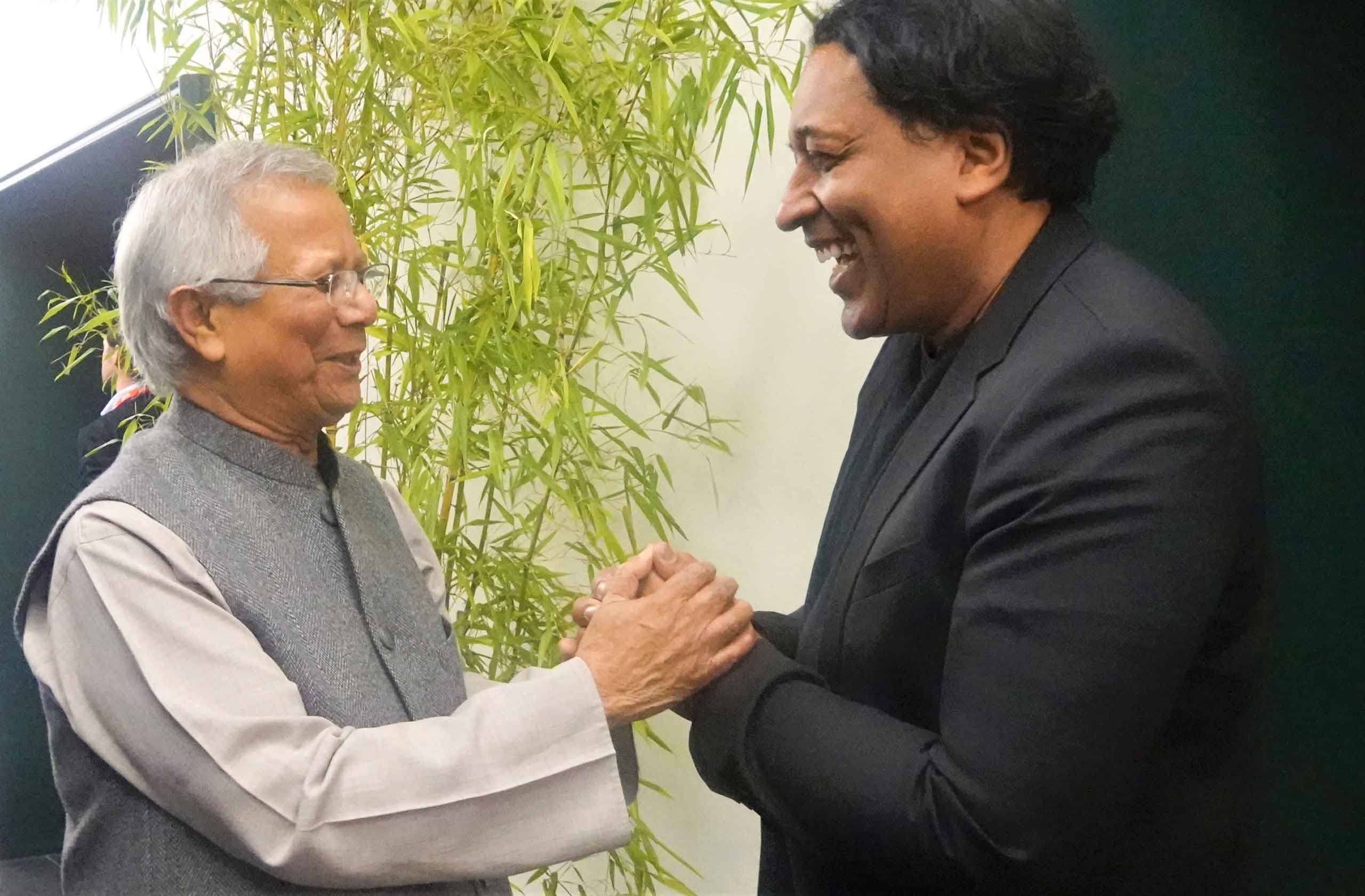
The Nobel Peace Prize laureate reveals how a radical idea became a global movement, and why the future belongs to those who see problems differently.
Some people explain the world. Others change it. When Cherno meets Nobel Peace Prize laureate Muhammad Yunus, he expects a conversation about microcredit, poverty reduction, and economic development. What he gets is far more.
The conversation becomes an extraordinary masterclass in entrepreneurship, innovation, leadership and the power of ideas. In the courage to challenge systems that appear impossible to change. And in a question facing every CEO, board member, and decision-maker today:
How do you remain successful when old certainties collapse, and the rules are being rewritten?
Muhammad Yunus’ answer is as clear as it is radical: We must stop seeing the world only as it is. We must find the courage to imagine it as it could be.
The Greatest Innovations Don’t Begin With Technology. They Begin With a Different Point of View.
Muhammad Yunus becomes world-famous as the “Banker to the Poor.” In 2006, he and the Grameen Bank he founded are awarded the Nobel Peace Prize.
At first, his idea seems almost too simple to be revolutionary: Give small loans to people who have no assets, no collateral, and no access to the traditional banking system. No millions. No complicated financial products. Just enough capital to start a small business, buy tools, or produce goods. Enough to take the next step through their own efforts.
Yunus tells Cherno how women and small-business owners in developing countries are routinely excluded from the formal financial system. Without collateral, their only option is often to turn to informal lenders and loan sharks.
The interest rates are extreme. The dependency is brutal. Escape appears impossible. Yunus refuses to accept this logic.
Yunus doesn’t change people. He changes the system around them.
“I wanted to give money to people like this woman so that they would be free from the moneylenders to sell their product at the price which the markets gave them—which was much higher than what the trader was giving them.” This idea leaves a lasting impression on Cherno.
Muhammad Yunus does not see poor people as helpless recipients. He recognizes something in them that the established economic system fails to see initiative, creativity, and entrepreneurial energy.
“In my experience, poor people are the world’s greatest entrepreneurs. Every day, they must innovate in order to survive.” They do not remain poor because they lack ideas. They remain poor because they lack the opportunity to turn their ideas into sustainable income.
Perhaps the World Doesn’t Lack Talent. Perhaps It Lacks Access.
“All human beings are born entrepreneurs. Some get a chance to unleash that capacity. Some never get the chance and never discover that they have that capacity.”
This is more than a statement about poverty. It is a provocation for every organization. How much ability remains invisible inside companies because processes, hierarchies, and biases keep it hidden? How many ideas never reach the boardroom? How many people are judged by their status rather than their potential?
Muhammad Yunus makes one thing clear: Innovation does not happen exclusively in research centers, strategy meetings, or executive suites. It happens wherever people are forced to solve a real problem.
The defining leadership question is therefore not simply: Who has talent? It is: Who gets the opportunity to show it?
For CEOs and boards, this creates a concrete responsibility: Open up access. Create room for decisions. Put capital, knowledge, and responsibility where new solutions can emerge.
This perspective also shapes Cherno’s work as a strategic sparring partner for senior leaders. He challenges decision-makers to question familiar ways of thinking, identify blind spots, and turn complex change into clear choices and decisive action.
Because transformation rarely fails due to a shortage of presentations. It fails because of the power of outdated assumptions.
The Most Dangerous Prison Is Built from Familiar Thoughts
“My greatest challenge has been to change the mindset of people. Mindsets play strange tricks on us. We see things the way our minds have instructed our eyes to see.” These words stay with Cherno because they capture the essence of every genuine transformation.
People do not merely defend existing processes. They defend their understanding of what is possible, reasonable, and realistic.
That is true in the fight against poverty. It is equally true of digital transformation, artificial intelligence, new business models, and organizational change.
The most dangerous statement in revolutionary times is therefore not: “That won’t work.” It is: “We’ve never done it that way before.”
Muhammad Yunus proves that what appears to be a law of nature may simply be a convention that has gone unquestioned for too long.
Banks believed poor people were not creditworthy. Yunus asked different questions: What if the people are not the risk? What if the real problem is a financial system that fails to recognize their capabilities? This shift in perspective gives rise to the Grameen Bank. A local idea becomes a global movement.
Money Is Not an End in Itself. It Is Stored Opportunity.
“Money begets money. If you don’t have that, you wait around to be hired by somebody and remain at the mercy of others. If you have that money in your hand, you desperately try to make the best use of it and move ahead. And that generates income for yourself.”
Yunus does not romanticize poverty. He demonstrates what capital can accomplish when it does not make people dependent but gives them the power to act.
Even the smallest amounts can set a cycle in motion:
Capital becomes initiative.
Initiative becomes income.
Income builds reputation.
Reputation opens up new access.
That is the true snowball effect of microcredit. What matters is not the size of the first step, but the momentum it creates.
Transformation begins with a smart first move.
For leaders, this contains a crucial lesson: Transformation does not always begin with the biggest budget. It often begins with the smartest first move.
Successful decision-makers do not wait for perfect conditions. They identify the lever that creates momentum, builds trust, and opens the door to new possibilities.
What CEOs Can Learn from a Rockstar of Social Innovation
Rockstars do not become rockstars by playing every note like everyone else. They become rockstars because they develop an unmistakable sound. Because they master the rules, and then find the courage to reinterpret them. Because they champion an idea so consistently that skepticism becomes attention, and attention becomes a movement.
Muhammad Yunus is a rockstar in precisely this sense. Not because of volume. Because of impact. That’s Leadership!
He sees what others overlook. He starts small. He stays true to his idea. And he proves that an economic innovation can be financially viable, scalable, and socially relevant at the same time.
What leaders, and all of us, can learn from him:
Challenge the fundamental assumption.
The greatest opportunity often lies where an industry has stopped asking questions.
Begin with the real problem.
Technology is not the starting point. A specific human need is.
Build an infrastructure for potential.
Talent alone changes nothing. It needs access, capital, trust, and room to act.
Start small but think in systems.
A microloan may be a small amount of money. Its impact can transform entire lives and communities.
Turn an idea into a movement.
Revolutionary solutions require more than strategy. They need a story people can understand, share, and support.
Business Can Do More Than Generate Profits
Muhammad Yunus does not reject capitalism. He expands it. “The profit orientation is only one orientation of a person. The same people who are interested in profit-making are also selfless. I am not saying that capitalist theory is wrong. I am saying that it has not been interpreted and practiced fully.”
His demand is provocative: The structure of capitalism must be completed through social businesses—companies whose primary purpose is not to maximize distributions to shareholders, but to solve a social or environmental problem.
“Business is a very beautiful mechanism to solve problems, but we never use it for that purpose. We only use it to make money. It satisfies our selfish interest but not our collective interest.”
This is not a criticism of business success. It is a more ambitious definition of it. Because “human beings”, as Yunus says, “are much bigger than just making money.”
For boards, this does not mean abandoning profitability. It means thinking more precisely about the purpose profitability serves. Which problems does the company solve? What value does it create for society? And why should customers, talent, and investors continue to believe in its future?
Purpose without a viable business model remains a statement of intent. Profit without social relevance ultimately loses its legitimacy. The future belongs to companies that can combine both.
Technology Does Not Decide our Future
“While technology is important, it’s what we do with it that truly matters.” In our time when artificial intelligence is reshaping entire industries, this message could hardly be more relevant. Technology is not the destination. It is an amplifier.
It can democratize access or concentrate power. It can empower people or make them feel obsolete. It can solve social problems or accelerate existing inequalities. That is why adopting new technology is not enough.
Leadership must decide what purpose that technology will serve.
Not: What can AI do?
But: What do we want AI to improve?
Not: Which processes can we automate?
But: What new possibilities can we create for customers, employees, and society?
Not: How quickly can we scale?
But: What exactly are we scaling?
This is where strategic sparring becomes invaluable. Cherno combines the perspective of a journalist with the experience of an executive coach. He asks the questions that are easily lost under day-to-day operational pressure, but that ultimately determine the direction, trust, and impact of a transformation.
To Shape the Future, You Must First Be Able to Imagine It
Yunus calls it “social fiction.” “To overcome poverty and the flaws of the economic crisis in our society, we need to envision our social life. We have to free our mind, imagine what has never happened before, and write social fiction. We need to imagine things to make them happen. If you don’t imagine, it will never happen.”
This idea is one of the reasons the encounter leaves such a powerful impression on Cherno. Yunus is not a naïve dreamer. He is an economist. An entrepreneur. A bank founder. A Nobel Peace Prize laureate. But he understands something that many boardrooms underestimate:
Every transformation begins as an idea.
Before a new reality can be built, someone must have the courage to describe it. Strategy is therefore more than analysis. It is the ability to articulate a future that does not yet exist but is concrete enough to move people into action.
Vision without execution is fantasy.
Execution without vision is administration.
Successful leadership connects the two.
Poverty Is Not an Unchangeable Destiny
“Poverty is an artificial, external imposition on a human being; it is not innate in a human being. And since it is external, it can be removed. It is just a question of doing it.” It lands like a knockout punch, because it sounds so simple.
Muhammad Yunus is a master of powerful messages: Systems are made by people. Therefore, people can change them.
Yunus’ own story embodies this conviction. Access to quality education allows him to reach far beyond the Bangladeshi village where he grew up. He earns his doctorate in economics from Vanderbilt University in the United States. Later, he uses this knowledge not to distance himself from the poverty of his homeland, but to change the mechanisms that perpetuate it.
“Access to quality education has enabled me to reach far beyond the Bangladeshi village I grew up in.” This, too, is a leadership lesson.
Success is not defined only by how far you rise. It is also defined by how many opportunities you create for others.
Resilience Is Not a Slogan. It Is Human Potential.
“Human beings have enormous resilience.” Yunus does not encounter this resilience in management seminars. He sees it in people who must improvise every day to feed their families.
That changes how we think about performance. Companies often talk about resilience as though it was one more competency on an HR checklist.
Yunus shows what it truly means: remaining capable of action under extreme pressure, using limited resources creatively, and continuing to search for possibilities even under the most difficult circumstances.
The task of good leadership is not to demand limitless resilience from people. It is to create conditions in which that strength is not exhausted but enabled to deliver meaningful results.
A Promise That Goes Beyond the Conversation
At the end of their conversation, Muhammad Yunus asks Cherno Jobatey to make him a promise: As a journalist, he must continue to beat the drum in the fight against global poverty.
Cherno promises he will. That moment stays with him. Because Yunus does not merely talk about responsibility. He transfers it. He turns a conversation into a mission.
And perhaps that is his greatest strength: Muhammad Yunus does not only change systems. He changes the perspective of the people he meets. Leadership par excellence!
The encounter impresses Cherno because Yunus radically redefines success. Not as status. Not as wealth. Not as personal triumph. But as the ability to create new possibilities for others.
The Future Does Not Wait for Realistic Ideas
In revolutionary times, it is not enough to manage existing models more efficiently.
Leaders must identify the assumptions that limit their organizations. They must turn technological change into human progress. And they must find the courage to imagine solutions that may appear unrealistic today.
Muhammad Yunus shows how: See what others overlook. Question what others consider settled. Start small. Act consistently. Build trust. Scale impact. And never forget that business becomes most powerful when it solves real problems.
Rockstars do not follow the rhythm of their time. They change it.
Muhammad Yunus has done exactly that. And his message to today’s decision-makers could not be clearer:
If you cannot imagine a better future, you will never create it.